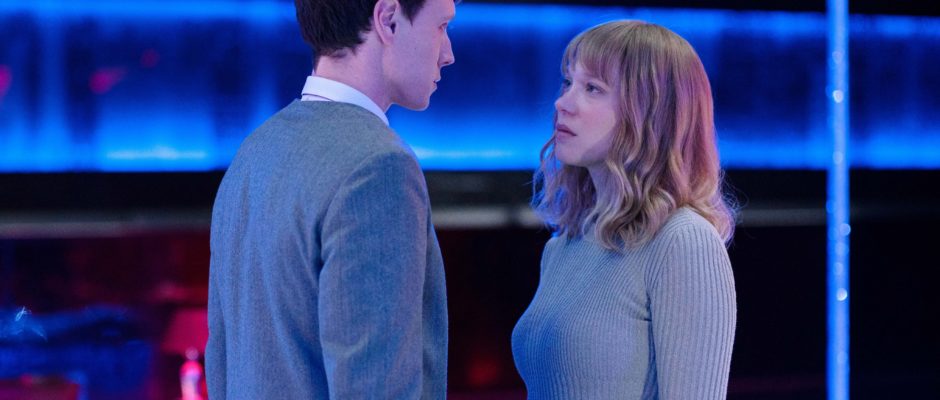
Revisiting Silk Stalkings: Lev Kalman and Whitney Horn on IFFR 2024 Premiere Dream Team

Dream Team, the third feature by Lev Kalman and Whitney Horn, is another in the writer-director duo’s run of genre pastiches that double as sociopolitical parables. Here, the influence of ’90s basic cable TV thrillers is channeled into an episodic story about a pair of Interpol agents (Esther Garrel and Alex Zhang Hungtai) who travel to Mexico to investigate the mysterious death of a corral smuggler. Shot by Horn in characteristically textured 16mm, the film unfolds between a variety of West Coast locales stretching from Baja California to Vancouver. As the body count rises and rumors of a physic coral […]

The post Revisiting Silk Stalkings: Lev Kalman and Whitney Horn on IFFR 2024 Premiere Dream Team first appeared on Filmmaker Magazine.

Revisiting Silk Stalkings: Lev Kalman and Whitney Horn on IFFR 2024 Premiere Dream Team Read More »

SXSW Announces 50 New Projects for Its 2024 Program, Including Films from Michael Mohan, Nicole Riegel and Alice Lowe

The SXSW Film Festival announced today 50 new films, XR projects and television programs that complete the 2024 SXSW Film & TV Festival lineup. Among the world premieres are the latest from The Voyeurs director Michael Mohan, who reunites with star Sydney Sweeney in Immaculate; Dev Patel’s action thriller Monkey Man; Alice Lowe’s followup to her Prevenge, Timestalker; and a new film from The Disappearance of Eleanor Rigby director Ned Benson, The Greatest Hits. Festival favorites traveling from Park City to Austin include Didi, Black Box Diaries, Love Machina, Ghostlight and I Saw the TV Glow. Of particular interest to […]

The post SXSW Announces 50 New Projects for Its 2024 Program, Including Films from Michael Mohan, Nicole Riegel and Alice Lowe first appeared on Filmmaker Magazine.

SXSW Announces 50 New Projects for Its 2024 Program, Including Films from Michael Mohan, Nicole Riegel and Alice Lowe Read More »

“This World That Molly and the Team Created For Us, is the Dream as an Actor”: How To Have Sex Star Mia McKenna-Bruce, Back To One, Episode 277

Mia McKenna-Bruce is an English actress. Her performance in the film How To Have Sex is, rightfully, being spoken about with many superlatives. Subtle, controlled, thoroughly alive, deeply impacting, it is a star-making turn. There’s a scene where her character, Tara, is simply walking down the street, and it’s something of a revelation. It won her the BIFA for Best Lead Performance. On this episode, she breaks down the ingredients that helped her deliver this work—an extensive audition process to find her co-stars that allowed her time to play; complete trust in the director, Molly Manning Walker, and everyone on […]

The post “This World That Molly and the Team Created For Us, is the Dream as an Actor”: How To Have Sex Star Mia McKenna-Bruce, Back To One, Episode 277 first appeared on Filmmaker Magazine.

“This World That Molly and the Team Created For Us, is the Dream as an Actor”: How To Have Sex Star Mia McKenna-Bruce, Back To One, Episode 277 Read More »

“A Cinema of Deconstructed Painting”: Antoinetta Angelidi and Rea Walldén on the Rotterdam-Premiering Obsessive Hours at the Topos of Reality

Little known in the Anglophone film world (although a recent book in Cambridge University Press’s ReFocus series might suggest an impending course correction), Antoinetta Angelidi is one of the most creative and distinct directors of the last half-century. Raised in and around Athens, Angelidi found solace in art in her adolescence after a traumatic childhood rape left her speechless. Though she initially took to painting, she was an avid moviegoer and, later, after a dream in which a Magritte-styled work exhibited a tiny movement, she turned to cinema. A student activist, she fled Greece for Paris with just the clothes […]

The post “A Cinema of Deconstructed Painting”: Antoinetta Angelidi and Rea Walldén on the Rotterdam-Premiering Obsessive Hours at the Topos of Reality first appeared on Filmmaker Magazine.

“A Cinema of Deconstructed Painting”: Antoinetta Angelidi and Rea Walldén on the Rotterdam-Premiering Obsessive Hours at the Topos of Reality Read More »

112 Days in Iceland: DP Florian Hoffmeister on True Detective: Night Country

Two women shine their flashlights while standing in a dark, snowy landscape.

The diversity of cinematographer Florian Hoffmeister’s output makes it difficult to typecast him. The German DP won an Emmy for his work on a BBC version of Great Expectations and followed with the Rowan Atkinson spy spoof Johnny English Strikes Again. Then, in succession, he lensed the Scott Cooper horror flick Antlers, the Apple prestige drama Pachinko and Todd Field’s Tár, picking up an Oscar nomination for the latter. But with True Detective: Night Country, Hoffmeister returns to a previous specialty–unsettling subzero horror. Hoffmeister’s work on AMC’s The Terror followed an ill-fated 19th century artic expedition. He’s back to frigid […]

The post 112 Days in Iceland: DP Florian Hoffmeister on True Detective: Night Country first appeared on Filmmaker Magazine.

112 Days in Iceland: DP Florian Hoffmeister on True Detective: Night Country Read More »

“I Come From the One-Woman-Band Show of Visual Journalism…”: Emily Kassie on Producing Sugarcane

Close-up of Julian Brave NoiseCat, a member of Shuswap Nation.

Tackling a timely but under-discussed contemporary issue in both the United States and Canada, journalists Julian Brave NoiseCat and Emily Kassie (A Girl Named C) investigate a string of abuses and missing persons cases at an indigenous residential school in Sugarcane. Below, Kassie, who in addition to directing the film with NoiseCat produced it alongside Kellen Quinn. Below, she recounts her debut experience as a producer and how she made a transition from the world of visual journalism. Filmmaker: Tell us about the professional path that led you to produce this film, your first? What jobs within and outside of […]

The post “I Come From the One-Woman-Band Show of Visual Journalism…”: Emily Kassie on Producing Sugarcane first appeared on Filmmaker Magazine.

“I Come From the One-Woman-Band Show of Visual Journalism…”: Emily Kassie on Producing Sugarcane Read More »

“The Bizarre Thing about 35mm is that It’s Almost Ageless”: Kleber Mendonça Filho on Pictures of Ghosts

A white movie screen pours light onto a full auditorium of moviegoers.

Fading though they are, I still have fond memories of the UA Crossbay I movie theater in Ozone Park. Founded in 1924, the Queens theater went out of business in 2005 and was converted into a Modell’s Sporting Goods, then a Raymour & Flanigan furniture outlet (“sadly fitting,” writes one user in the comments section of the theater’s Cinema Treasures page, “since most people watch movies sitting or lying in their beds nowadays”). The marquee still remains, sporting a branded logo of its current tenant rather than a rundown of the week’s releases. I also remember having seen many movies […]

The post “The Bizarre Thing about 35mm is that It’s Almost Ageless”: Kleber Mendonça Filho on Pictures of Ghosts first appeared on Filmmaker Magazine.

“The Bizarre Thing about 35mm is that It’s Almost Ageless”: Kleber Mendonça Filho on Pictures of Ghosts Read More »

“Establishing the Idea of Ending Scenes Abruptly…”: Editor Greg Jardin on It’s What’s Inside

A woman bathed in purple light looks into a broken mirror

In the Sundance 2024 Midnight premiere It’s What’s Inside, the feature debut of writer-director Greg Jardin, an uninvited guest with a mysterious suitcase derails a pre-wedding party. Below, Jardin discusses what led him to edit his own film, the balance between long shots and flutter cuts, and more. See all responses to our annual Sundance editor questionnaire here. Filmmaker: How and why did you wind up being the editor of your film? What were the factors and attributes that led to your being hired for this job? Jardin: I started out directing low-budget music videos, which I more or less […]

The post “Establishing the Idea of Ending Scenes Abruptly…”: Editor Greg Jardin on It’s What’s Inside first appeared on Filmmaker Magazine.

“Establishing the Idea of Ending Scenes Abruptly…”: Editor Greg Jardin on It’s What’s Inside Read More »

“Ninety Percent of Our Film Takes Place In One Location” | Greg Jardin, It’s What’s Inside

Films are made of and from places: the locations they are filmed in, the settings they are meant to evoke, the geographies where they are imagined and worked on. What place tells its own story about your film, whether a particularly challenging location that required production ingenuity or a map reference that inspired you personally, politically or creatively?  Ninety percent of our film takes place in one location, which makes that the default answer – a giant house in the middle of nowhere. The whole impetus behind the film’s premise was coming up with something that could unfold in a single […]

The post “Ninety Percent of Our Film Takes Place In One Location” | Greg Jardin, It’s What’s Inside first appeared on Filmmaker Magazine.

“Ninety Percent of Our Film Takes Place In One Location” | Greg Jardin, It’s What’s Inside Read More »

“The Grandest Orphan Cinema”: Ehsan Khoshbakht on MoMA’s “Iranian Cinema before the Revolution, 1925–1979” Series

A woman kneels before in a woman in a wheelchair in an opulent room.

Starting with a packed house on the night of October 13 and concluding right after Thanksgiving, MoMA showcased “Iranian Cinema before the Revolution, 1925–1979,” the largest retrospective of Iranian cinema ever held inside or outside of Iran. With close to 70 films covering the pre-revolutionary period, there were works from Iran’s most famous filmmaker, Abbas Kiarostami; the most famous film of this era, the late Dariush Mehrjui’s The Cow; and repertory favorites like Ebrahim Golestan’s Brick and Mirror, Bahram Beyzaie’s Downpour and Forough Farrokhzad’s The House is Black. But, significantly, there were also films by lesser-known but just as vital […]

The post “The Grandest Orphan Cinema”: Ehsan Khoshbakht on MoMA’s “Iranian Cinema before the Revolution, 1925–1979” Series first appeared on Filmmaker Magazine.

“The Grandest Orphan Cinema”: Ehsan Khoshbakht on MoMA’s “Iranian Cinema before the Revolution, 1925–1979” Series Read More »

Scroll to Top